Corruption Perceptions Index 2025
Corruption Perceptions Index
Who will take the lead in the fight against corruption?
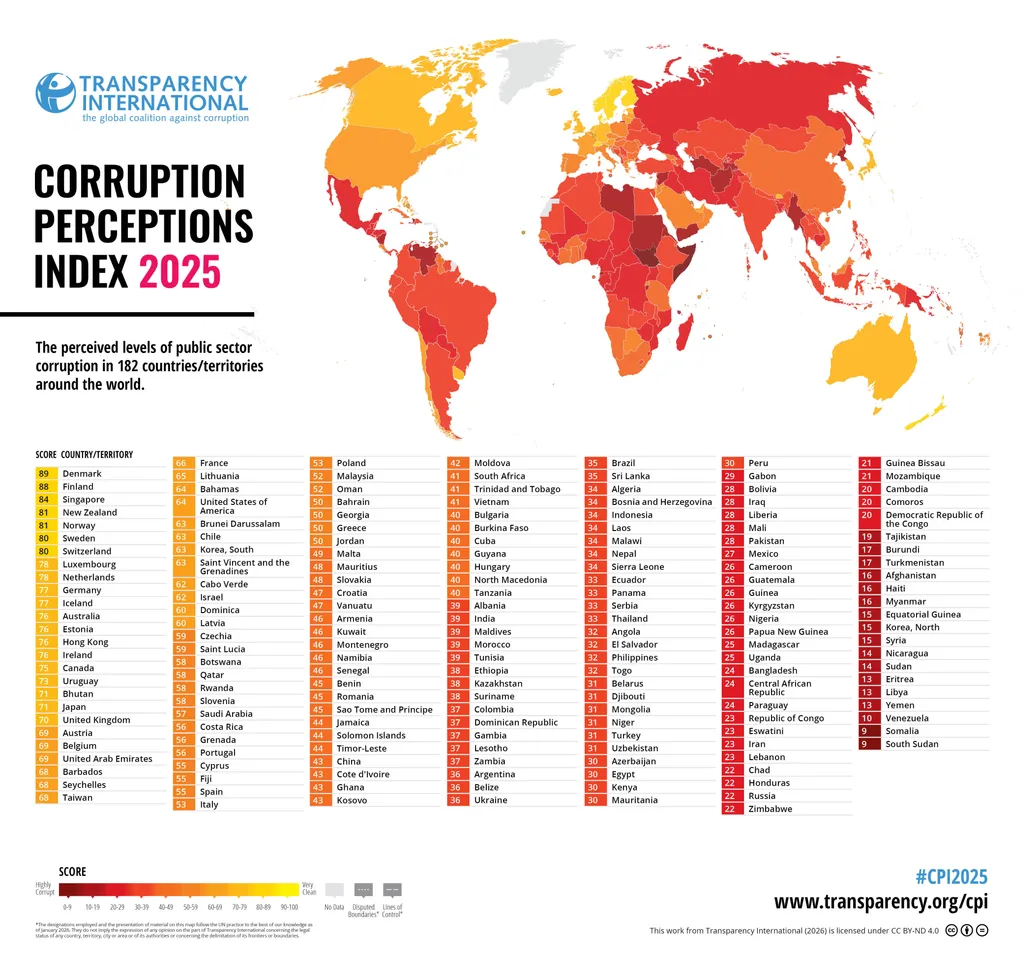
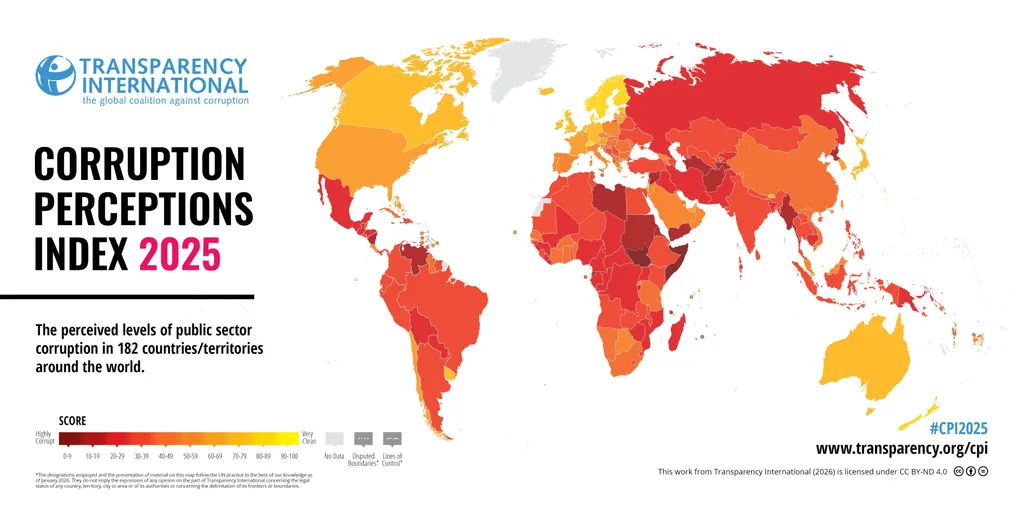
The 2025 Corruption Perceptions Index (CPI) shows that corruption remains a serious threat in every part of the world, although there are limited signs of progress.
Leaders must act to tackle abuses of power and the wider factors driving this decline, such as the roll-back of democratic checks and balances, and attacks on independent civil society.
Anti-government protests in many parts of the world show that people are fed up with unaccountable leadership and are demanding reform.
The CPI ranks 182 countries and territories worldwide by their perceived levels of public sector corruption. The results are given on a scale of 0 (highly corrupt) to 100 (very clean).
While 31 countries have significantly reduced their corruption levels since 2012, the rest are failing to tackle the problem – they have stayed stagnant or got worse during the same period. The global average has fallen to a new low of 42, while more than two-thirds of countries score below 50. And people are paying the price, as corruption leads to under-funded hospitals, unbuilt flood defences and blights the hopes and dreams of young people.
The anti-corruption leadership gap
We’re seeing a concerning picture of long-term decline in leadership to tackle corruption. Even established democracies, like the US, UK and New Zealand, are experiencing a drop in performance. The absence of bold leadership is leading to weaker standards and enforcement, lowering ambition on anti-corruption efforts around the world.
At the same time, many states are increasing restrictions on civic space. By making it hard or dangerous for citizens, NGOs and journalists to challenge abuses of power, they are reducing transparency and accountability. This allows corruption to flourish.
Nations with the least corrupt public sectors can still have serious integrity issues, even if the CPI does not measure them – many enable corruption in other countries by facilitating the transfer of proceeds of corruption across borders and into money laundering schemes.
It doesn't have to be this way. Our research and experience as a global movement fighting corruption show there is a clear blueprint for how to hold power to account for the common good. Progress is possible with action to strengthen justice systems, enhance oversight of public services and spending, and keep secret money out of elections. It is also vital to protect civic space, democracy and media freedom, while closing the secrecy loopholes that let corrupt money move across borders.
At a time of climate crisis, instability and polarisation, the world needs accountable leaders and independent institutions to protect the public interest more than ever – yet, too often, they are falling short. We’re calling on governments and leaders to act with integrity and live up to their responsibilities to provide a better future for their citizens.

CPI 2025: Findings and insights
News •
As corruption worsens globally, a decline in bold, accountable leadership is undermining reform.

What’s happening around the world?
Whether they are dealing with a recent wave of backsliding or struggling with broader challenges that have long undermined reform, every region has a lot of work to do to solve its corruption problems. But almost all have success stories that show that progress is possible.
Eight countries have improved in Asia Pacific since 2012, however there are stark differences within this diverse region where many countries struggle with corruption. With well-connected elites often buying political influence and many laws not getting enforced properly, most leaders in this part of the world are not delivering on their commitments.
In the Americas, years of inaction by governments in addressing corruption has weakened democracy and allowed the growth of organised crime, with serious impacts on human rights and security.
Eastern Europe and Central Asia remains one of the world’s lowest-performing regions with widespread impunity for corruption being driven by the vested interests that dominate most governments and their institutions.
Weak democracy in much of Sub-Saharan Africa – sometimes paired with armed conflicts, insecurity and escalated civil unrest – continues to undermine governance, economic stability and development efforts.
Middle Eastern and North African governments are still failing to tackle public sector corruption, reflecting inconsistent commitment from leaders and the weakness of institutions that should hold power to account.
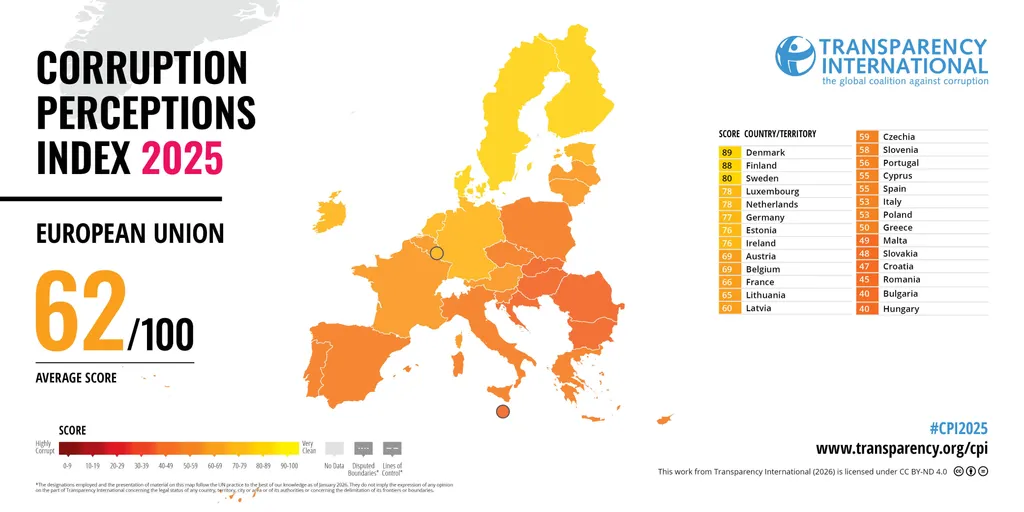
Western European nations make up nine of the top ten countries globally in the Corruption Perceptions Index. However, anti-corruption efforts have largely stalled in recent years, with the region’s average CPI score dropping quicker than any other.
Read about the key corruption issues, breakthroughs and solutions in seven parts of the world.

Corruption Perceptions Index 2025: Weak institutions are fuelling corruption in Eastern Europe and Central Asia

Corruption Perceptions Index 2025: Stalling anti-corruption progress in Asia Pacific while public anger surges

Corruption Perceptions Index 2025: Corruption across the Americas is damaging people’s lives and fuelling violence

Corruption Perceptions Index 2025: Stronger institutions, freer civic space needed in Middle East and North Africa

Corruption Perceptions Index 2025: Pacific governments falling short on anti-corruption commitments

Corruption Perceptions Index 2025: Public sector corruption sees Sub-Saharan Africa face the highest corruption levels globally

Corruption Perceptions Index 2025: Europe must step up leadership in the fight against corruption
Full 2025 Materials
Graphics to use and share

The CPI Explained
The CPI is the most widely used global corruption ranking in the world. But how is it calculated? What kinds of corruption does it cover? And why are certain countries not included? Watch this short explainer video, or dive straight into the most frequently asked questions.
